The short answer
Nightcore = faster + higher. A nightcore edit speeds a song up, typically 1.2–1.35×, and lets the pitch rise with it, about 3–5 semitones. The name comes from a Norwegian DJ duo who started doing this to trance songs in 2001.
What is nightcore music?
Nightcore is not a genre with its own instruments or song structure. It's a treatment you apply to an existing track: play it faster without correcting the pitch. The drums hit sooner, the BPM goes up, and every voice and instrument moves up in key. Vocals pick up the bright, slightly cartoonish "chipmunk" colour that people recognise in a second.
That's the whole nightcore meaning in sound. Online, the word also carries a look: for years, nightcore uploads on YouTube paired the faster audio with an anime-style illustration. Today you'll hear the same sound filed under "sped up", especially on short-video apps.
The method is old-fashioned varispeed. Play a 33⅓ rpm record at 45 rpm and you get roughly 1.35× speed and about five semitones of extra pitch: classic nightcore territory.
Where nightcore came from
The history is short, and it starts in Norway.
| When | What happened |
|---|---|
| 2001 | Norwegian DJs Thomas S. Nilsen and Steffen Ojala Søderholm (DJ TNT and DJ SOS) start Nightcore as a school project. Their recipe: trance and Eurodance tracks sped up by about 25–30%, often landing between 160 and 180 BPM. They credited the pitched-up vocals in Scooter's hardcore remixes as an inspiration. |
| 2002 | The duo's debut album, Energized, comes out. Four more sped-up trance albums follow. |
| 2003–2006 | Their tracks circulate on LimeWire (2003) and the first nightcore upload appears on YouTube (2006). |
| 2008–2011 | YouTube uploaders repost the originals, then realise that any song can get the treatment with basic audio software. A nightcore edit of "Rockefeller Street", Estonia's 2011 Eurovision entry, becomes one of the first viral hits. |
| 2010s | The style spreads from dance music to pop and hip-hop, picks up its anime-art look, and producers in internet-born scenes start borrowing its pitched-up vocals. |
| 2020s | Short-video apps rename it sped up. A 2022 nightcore edit of Lady Gaga's "Bloody Mary" spreads with a viral Wednesday dance trend, and major labels begin releasing official sped-up versions. |


Nightcore vs sped up vs daycore
These labels overlap, and people use them loosely. The useful difference is direction and finish:
| Style | Speed | Pitch | How it usually sounds |
|---|---|---|---|
| Nightcore | 1.2–1.35× | +3 to +5 semitones | Bright, energetic, sometimes a touch of reverb |
| Sped up | 1.1–1.35× | Up | Same idea, usually dry; the TikTok-era name |
| Daycore | 0.75–0.85× | −3 to −5 semitones | Darker and heavier, often with reverb |
| Slowed + reverb | 0.8–0.9× | Down | Dreamy, washed in reverb |
If you like the idea but want it slow and moody, that's daycore. Our daycore maker and the slowed + reverb studio both use the same speed-and-pitch link, just below 1×.
Why nightcore sounds the way it does
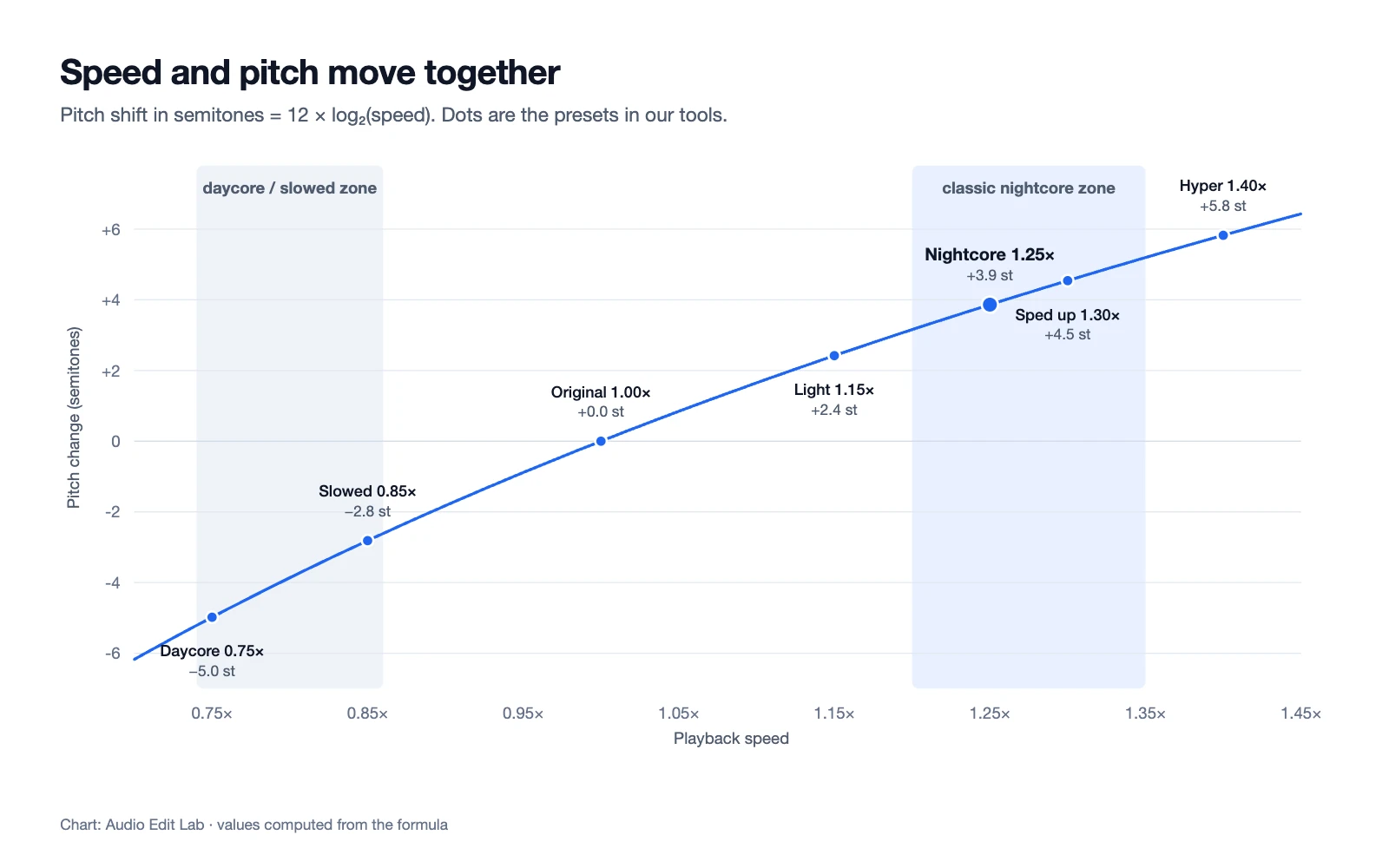
Speed and pitch are locked together in a nightcore edit. The pitch shift in semitones is 12 × log₂(speed), so the numbers grow quickly:
| Speed | Pitch | A 3:30 song becomes | A 120 BPM beat becomes |
|---|---|---|---|
| 1.15× | +2.4 st | 3:03 | 138 BPM |
| 1.25× | +3.9 st | 2:48 | 150 BPM |
| 1.30× | +4.5 st | 2:42 | 156 BPM |
| 1.35× | +5.2 st | 2:36 | 162 BPM |
Two things happen besides the key change. The tempo jumps (see what BPM means for why 120 → 150 feels so different), and the vocal formants, the resonances that make a voice sound like a particular person, shift up as well. That's why a nightcore singer sounds younger and smaller, not just higher. A pitch-preserving speed change keeps the formants in place, which is why it never sounds like nightcore.
How to make nightcore
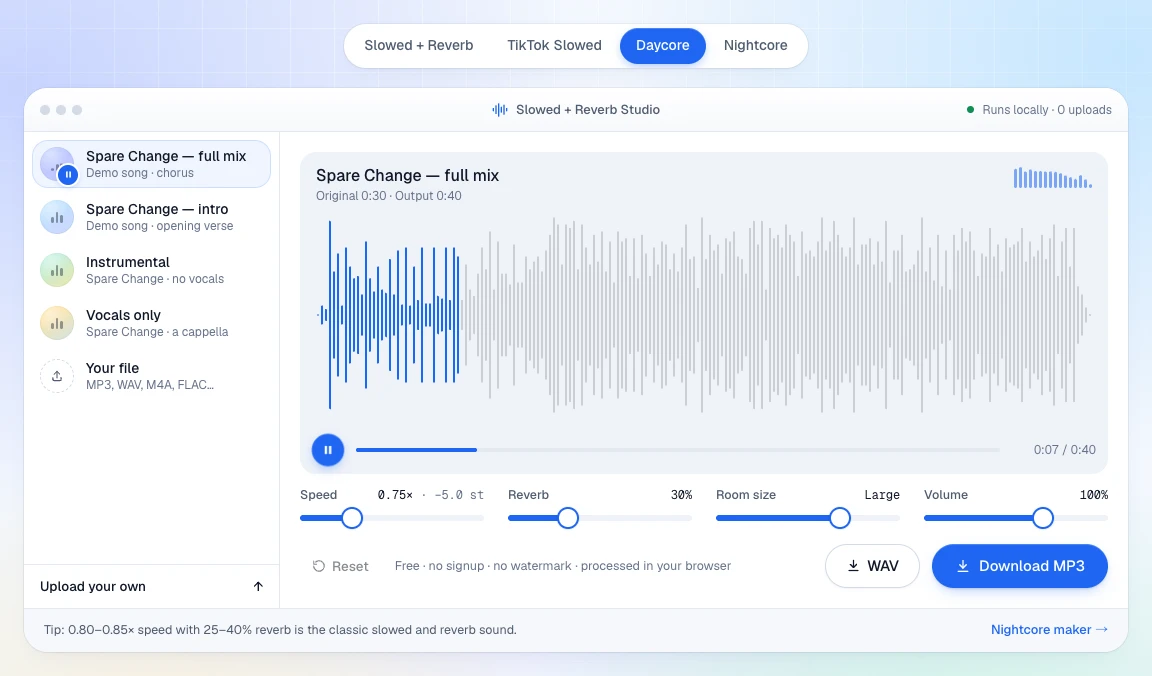
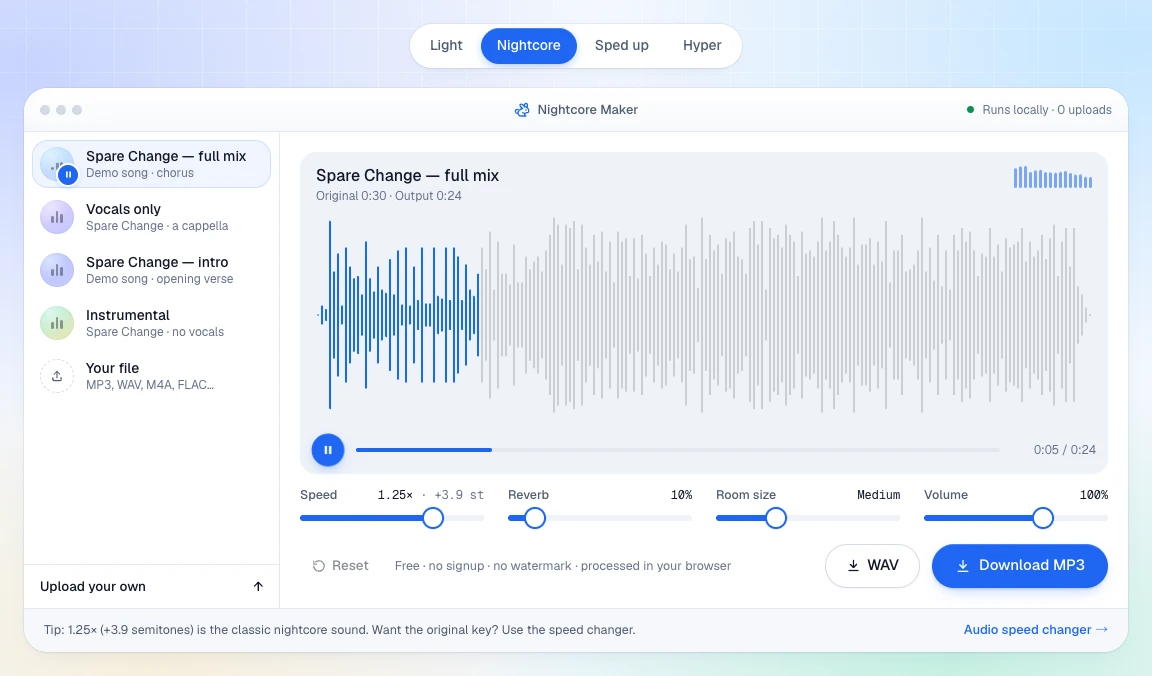
You don't need a DAW. Our nightcore maker runs in the browser and processes the song on your own device.
- 1
Add a song
Drop an MP3, WAV, M4A, OGG or FLAC file (up to 100 MB) onto the tool, or press play on a demo track to hear it first.
- 2
Pick a level
Nightcore (1.25×, +3.9 st) is the classic sound. Light (1.15×) suits busy vocals, Sped up (1.30×) is dry and punchy, and Hyper (1.40×) is for when you want it extreme.
- 3
Fine-tune by ear
Move the speed slider in small steps and listen to the chorus, where the highest notes live. Add a little reverb only if the track sounds thin.
- 4
Download
Save the result as MP3 (192 kbps) or WAV. Nothing is uploaded, and there's no watermark.
Tips for nightcore that sounds good
- Match the amount to the song. Songs that are already fast and high (around 160 BPM, bright female vocals) often need only 1.1–1.15×. Mid-tempo pop at 100–120 BPM can take 1.25–1.3×.
- Listen for harsh "s" sounds. Sibilance moves up into a sharper range when you speed up. If it stings, back off the speed before reaching for an EQ.
- Keep drum-heavy tracks dry. Reverb blurs fast kicks and snares; the Sped up preset skips it on purpose.
- Want faster but in the original key? That's a different effect. Use the audio speed changer, which keeps the pitch.
Posting nightcore online
Speeding up a song doesn't change who owns it, and platforms still recognise sped-up versions. Publish edits of music you have the rights to, such as your own tracks or licensed audio, and keep other edits for personal listening.