0:30
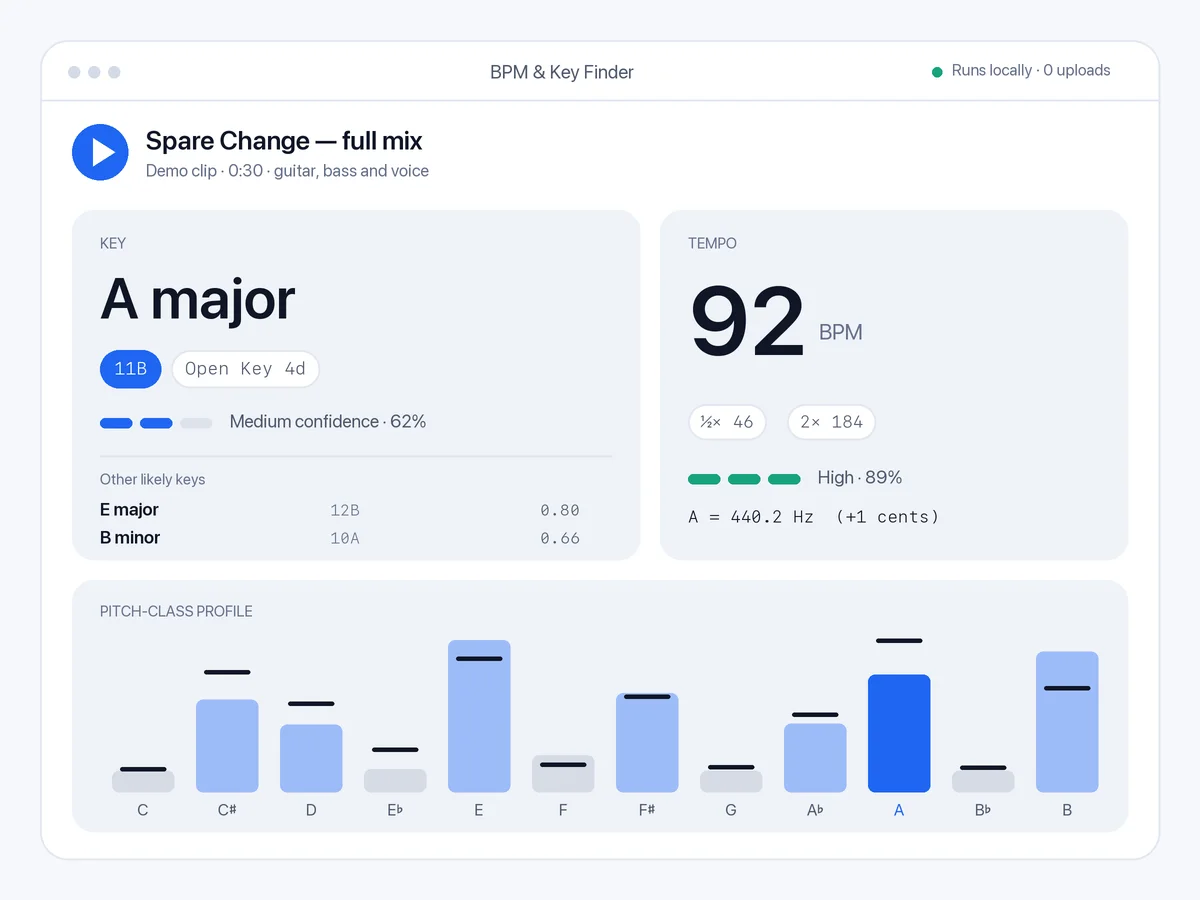
Full mix: A major, 92 BPM
11BA92 BPMMedium 62%
Guitar chords, bass and voice together. A major wins, with E major (a fifth above) close behind because the chorus leans on the E chord, so confidence is only medium.
This BPM key finder listens to any song right in your browser and tells you its tempo, musical key and Camelot code. Drop in one track or a whole folder; nothing is uploaded.
Spare Change — full mix
Demo clip · 0:30 · result from this finder
Key over timeOne key throughout
Key
A major
Other likely keys (correlation)
Tempo
92BPM
Tuning
A = 440.2 Hz (+1 cents)
Camelot wheel
Mix next (harmonic matches)
Pitch-class profile
How much of each note the finder heard, against the key's template
Tip: low confidence? Use a part with full chords rather than an intro or a drum break, or switch on the tonic drone and listen.
Results
Real runs of this key and BPM finder on one acoustic-pop demo: the chorus at three speeds, then the band, the instruments and the voice on their own. Press play and compare what you hear with what it found.
Same chorus, three speeds
Varispeed edits like nightcore and daycore move pitch with tempo. At 1.25× the chorus rises about four semitones, from A major (11B) to D♭ major (3B); at 0.75× it drops five, to E major (12B). Switch versions while it plays.
0:30
| Version | Key | Camelot | BPM | Tuning |
|---|---|---|---|---|
| Original | A | 11B | 92 | +1¢ |
| Nightcore | D♭ | 3B | 115 | −12¢ |
| Daycore | E | 12B | 69 | +3¢ |
The tempo follows: 92 BPM becomes 115 and 69. And 1.25× is 3.86 semitones, not 4, so the sped-up version sits about 12 cents flat of D♭ major.
Guitar chords, bass and voice together. A major wins, with E major (a fifth above) close behind because the chorus leans on the E chord, so confidence is only medium.
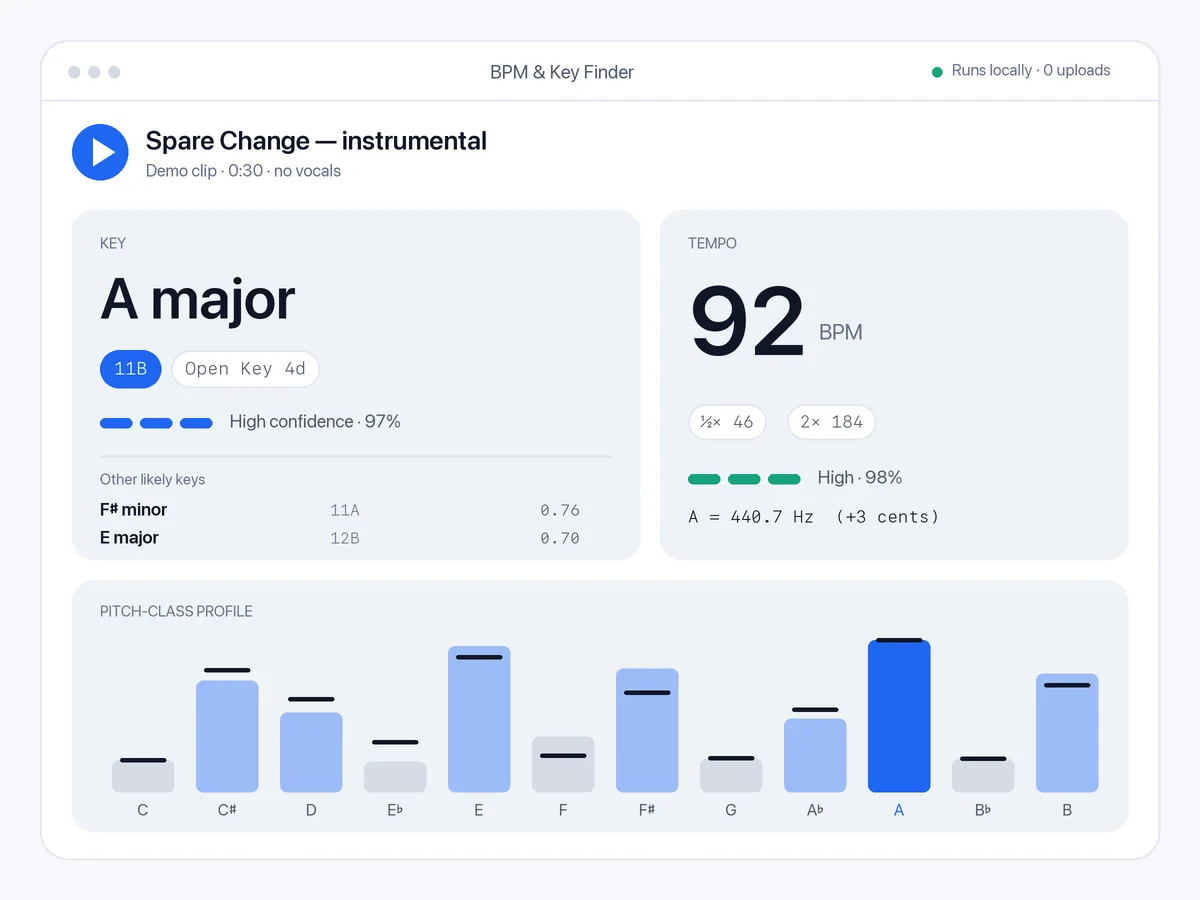
Without the vocal the chords speak clearly: A major with high confidence and the same 92 BPM grid. Instrumentals and full mixes are the most reliable inputs.
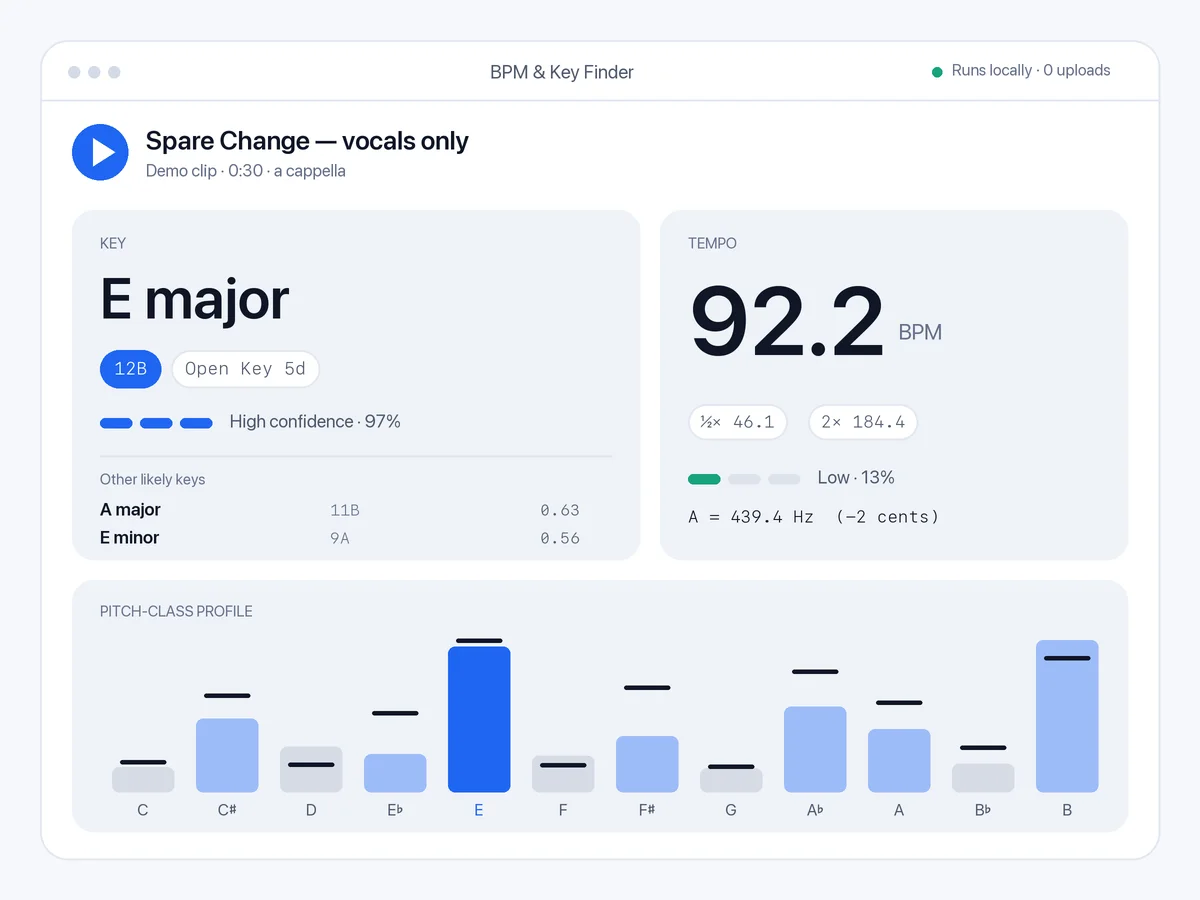
The a cappella circles E and B, so on its own it points a fifth higher than the song. The BPM confidence also drops, because a voice has few sharp attacks. Analyse the whole mix when you can.
How it works
Three steps, no account. This tempo and key finder analyses each song on your device, so even a folder of WAVs costs no upload time.
MP3, WAV, M4A, OGG or FLAC, analysed one after another: 3 at a time and up to 50 MB each free, 100 at a time and 500 MB each with Pro.
Key with its relative major or minor, Camelot and Open Key codes, tempo with half and double time, and a confidence for each.
Play it with a beat click and a tonic drone to confirm, then copy the result or download the batch as CSV.
Under the hood
No black box. Here is what the BPM key finder computes for every song, and the numbers behind it.
Made for
Knowing the key and tempo saves guesswork wherever two pieces of music have to meet.

Sort your crate by Camelot code and move one step at a time (8A to 9A) so every blend stays in tune; match the BPM first.

Check a loop's or acapella's key and tempo before you build on it, then shift it into your project. Two semitones is often enough.

Find the original key of a cover or karaoke track, then move it a few semitones so the chorus sits in your range.
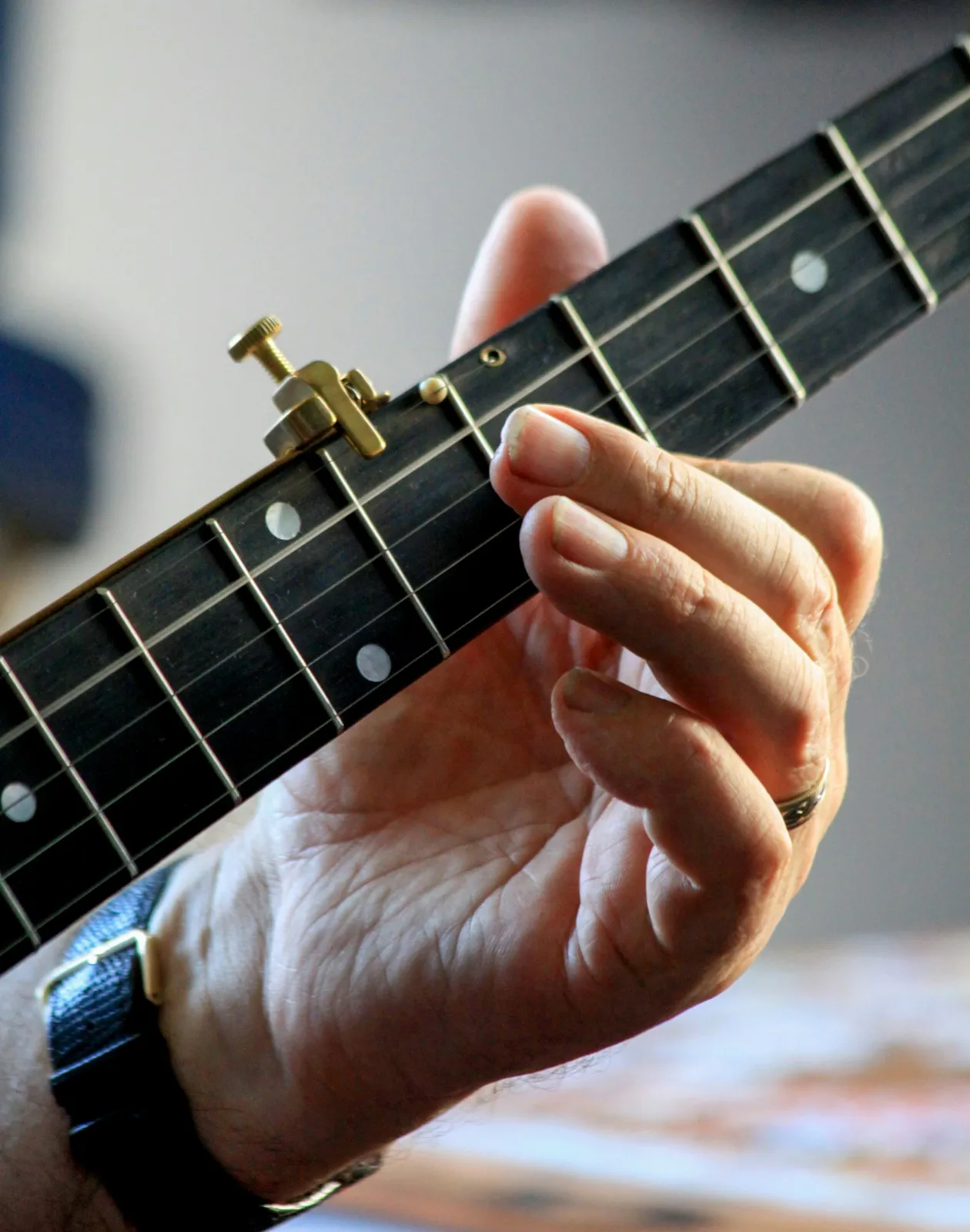
Knowing a song is in A major tells you its chords before you play a note; on guitar, capo 2 lets you use G shapes.
Camelot wheel guide
The Camelot wheel is the circle of fifths with simple codes: numbers 1 to 12 go round the clock, B is the major ring and A the minor ring. Keys that touch share most of their notes, so they mix cleanly. Pick any key to see its matches.
Click or tab to any segment. Blue is the selected key, light blue its harmonic matches.
Selected key
A minor 8A
Relative: C major
Harmonic mixing means blending tracks whose keys agree, so bass lines and chords don't clash in the overlap. A BPM key finder gives you both numbers up front: the tempo says how far to move the pitch fader, the Camelot code whether the blend will sound sweet or sour.
Safe moves: the same code, one step either way round the wheel, or straight across between A and B. Two steps up (+2) adds energy over a short blend. Anything further will clash unless only the drums overlap.
A pitch fader changes key as well as tempo: +6% is about one semitone, seven steps round the wheel. Use key lock, or move the file first with our pitch changer.
Why results can differ
Every song key finder, ours included, works out the key from the notes it hears. Usually they all point one way. These are the cases where they don't.
C major and A minor use the same seven notes; only the tonic, where phrases come to rest, tells them apart. That is why the relative key is always shown next to the result.
Many pop choruses lean on the chord a fifth above the tonic, pulling the profile toward the next key round the wheel. In our demo, A major wins and E major comes a close second.
Dorian, Mixolydian or a two-chord dance loop doesn't fit a major or minor template exactly. Expect the closest one, often a step away on the wheel.
A last chorus lifted a semitone, or a bridge in another key, splits the song. The headline is the key used most; the strip under the waveform shows where it moves.
Nightcore, daycore and slowed versions shift keys by uneven amounts, and old recordings may not sit at A = 440 Hz. The finder measures the offset first, then picks the nearest key.
With little harmony, a drum loop or rap verse gives a weak profile and low confidence. A lone voice tends to point to its melody's key rather than the song's.
We ran the finder on material with known keys. "Exact" means the same tonic and mode; "exact or close" also counts the relative key and keys a fifth away, mistakes that still mix well.
| Test set | Exact key | Exact or close |
|---|---|---|
| Synthetic chord progressionsI–IV–V–I and i–iv–V–i in all 24 keys, three tunings (72 clips) | 100% | 100% |
| Synthetic scalesUp and down one octave in all 24 keys (72 clips). All major scales are right, the C major render included; a bare minor scale has its relative major's notes, so all 36 land there | 50% | 100% |
| Classical pianoBach's Well-Tempered Clavier I (Kimiko Ishizaka's open recording) and Chopin preludes, 58 pieces | 86% | 97% |
| Electronic dance music61 tracks from the GiantSteps key dataset (2-minute previews, 77% minor), hard for every key finder | 43% | 75% |
Measured in November 2026 with the code that runs on this page. Template finders shine on tonal music; loop-based dance tracks are hard for all of them, hence the confidence meter, the alternatives and the tonic drone.
FAQ
Free · no signup · no watermark · processed in your browser
It decodes the song in your browser, then a background thread does two jobs. Tempo: it tracks onsets (sudden changes in the sound), autocorrelates them and refines the period to 0.1 BPM. Key: it folds the spectral peaks into a 12-note profile, corrects for tuning and correlates it with Krumhansl–Schmuckler templates for all 24 keys. The best match wins; the next ones are listed as alternatives.
In our tests it found the exact key of 86% of classical piano pieces and of every synthetic chord progression, but of only 43% of electronic dance tracks (75% exact or a close neighbour). Pop and rock with clear chords behave like the first group. Low confidence means double-check; the tonic drone lets you do it by ear.
Both are DJ shorthand for keys. Camelot numbers the circle of fifths 1 to 12, with A for minor and B for major: C major is 8B, A minor is 8A. Open Key (Traktor) uses d and m and starts at C major = 1d. Neighbouring numbers mix well.
Tempo is ambiguous by a factor of two: drum and bass at 174 BPM also pulses at 87, and a 90 BPM hip-hop beat can feel like 180. The finder shows the most likely value with the half- and double-time options next to it; use whichever your DJ software or genre expects.
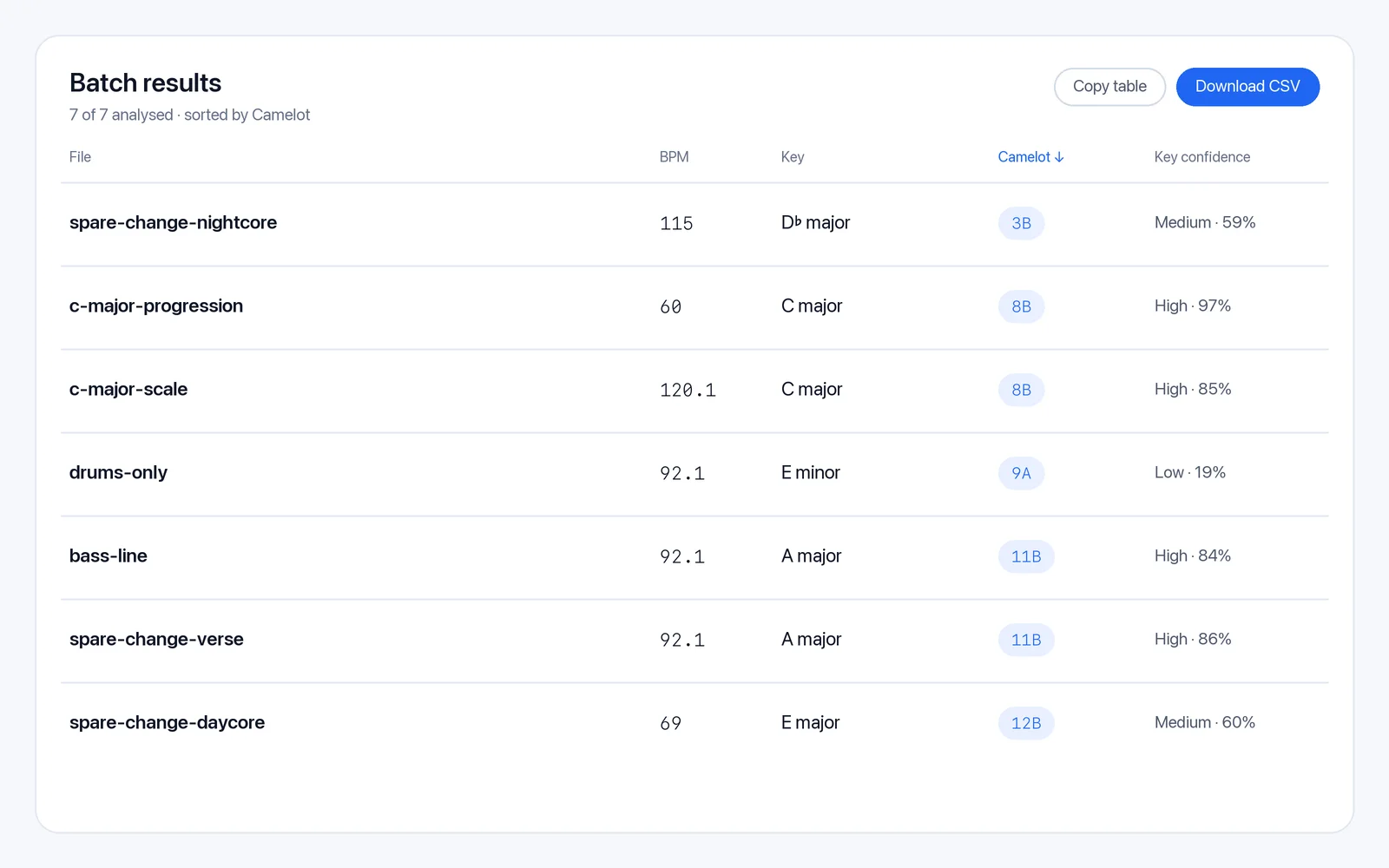
Yes. Drop several files at once: 3 at a time on the free plan, up to 100 with Pro (up to 50 MB each free, 500 MB with Pro). They are analysed one after another into a table you can sort by BPM or Camelot code, copy into a spreadsheet or download as CSV. Nothing is uploaded.
Yes. The pitch changer moves a song up or down in semitones without changing its speed; the BPM changer retimes it without changing its key. To set a tempo by hand, use the BPM tapper.
Drop in a song or a whole crate: tempo, key and Camelot code in seconds, right in your browser.