The short answer
BPM = beats per minute = tempo. 60 BPM is one beat per second, 120 BPM is two. Most popular songs sit somewhere between about 80 and 140 BPM, and the average hit lands near 120.
BPM meaning in music
A beat is the steady pulse under the music: the thing you nod to, clap on, or dance to. BPM simply counts how many of those pulses happen in a minute. In most pop, rock and dance music written in 4/4, one beat is a quarter note, and sheet music writes the tempo as "♩ = 120".
The arithmetic is handy: seconds per beat = 60 ÷ BPM.
| BPM | One beat every | One 4/4 bar every | Feels like |
|---|---|---|---|
| 60 | 1.00 s | 4.0 s | A slow ballad, a ticking clock |
| 90 | 0.67 s | 2.7 s | Laid-back hip-hop, R&B |
| 120 | 0.50 s | 2.0 s | Upbeat pop, a brisk march |
| 128 | 0.47 s | 1.9 s | House and EDM |
| 174 | 0.34 s | 1.4 s | Drum and bass |
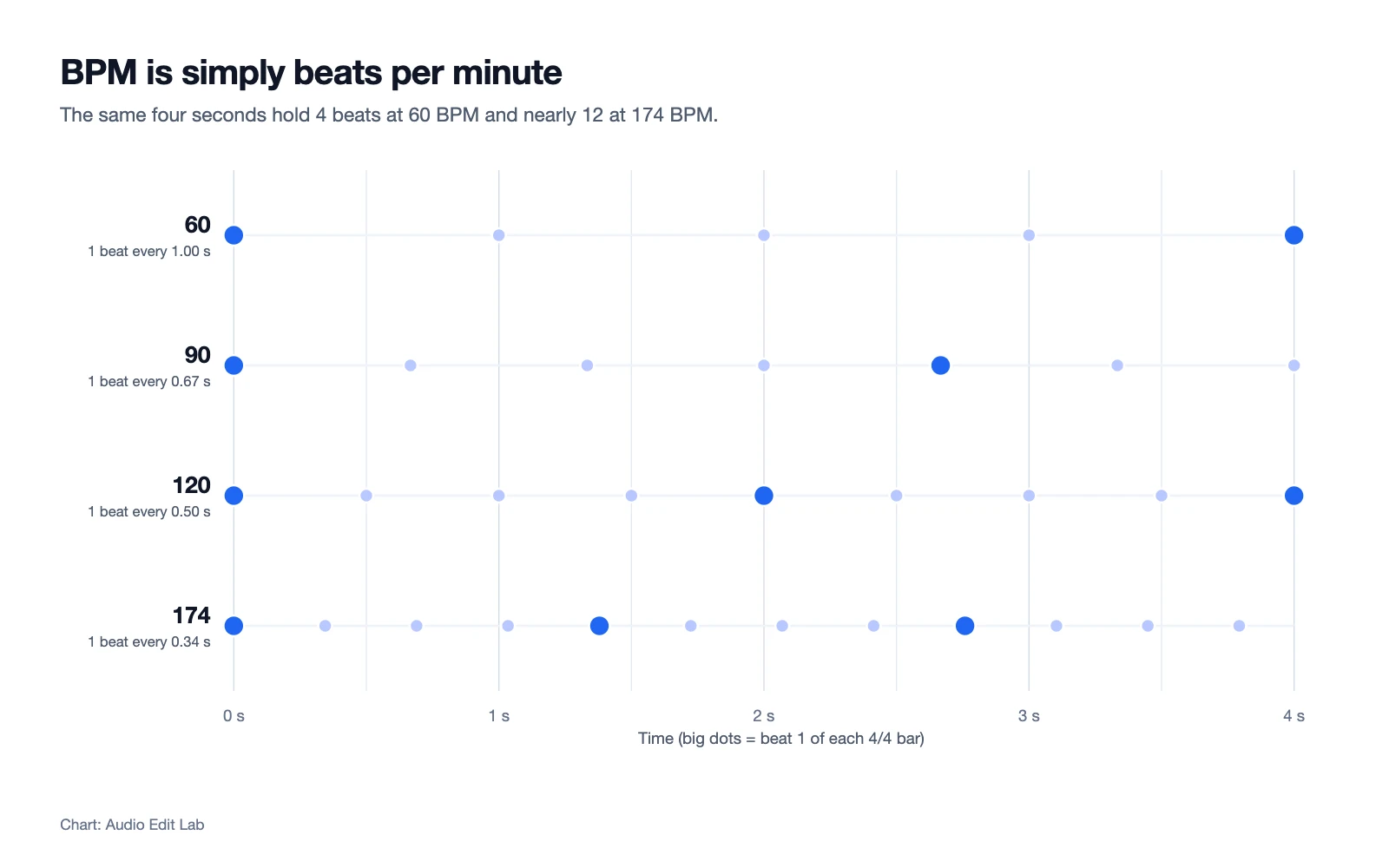
BPM is only the speed of the pulse. It says nothing about rhythm (which notes fall between the beats), meter (how beats group into bars) or how busy a song sounds. That's why two songs at the same BPM can feel completely different.
Where BPM came from: metronomes and tempo markings
For centuries composers described tempo in words, usually Italian: Largo, Andante, Allegro, Presto. That changed with the metronome. In 1815 Johann Maelzel patented a wind-up metronome, built largely on a mechanism by Dietrich Nikolaus Winkel, and its numbered scale let a composer write an exact speed. Marks such as "M.M. ♩ = 108" still stand for Mälzel's Metronome. In 1817 Beethoven became the first well-known composer to publish metronome marks, for his symphonies.
The old words survive as rough bands. Sources disagree on the exact edges, so treat these as approximate:
| Marking | Meaning | Approx. BPM |
|---|---|---|
| Largo | Slow and broad | 40–66 |
| Adagio | Slow, expressive | 44–66 |
| Andante | At a walking pace | 56–108 |
| Moderato | Moderate | 108–120 |
| Allegro | Fast and bright | 120–156 |
| Vivace | Lively and fast | 156–176 |
| Presto | Very fast | 168–200 |
Typical BPM by genre
Genres come with habits. Electronic music in particular is often labelled by tempo, because DJs need tracks that mix together.
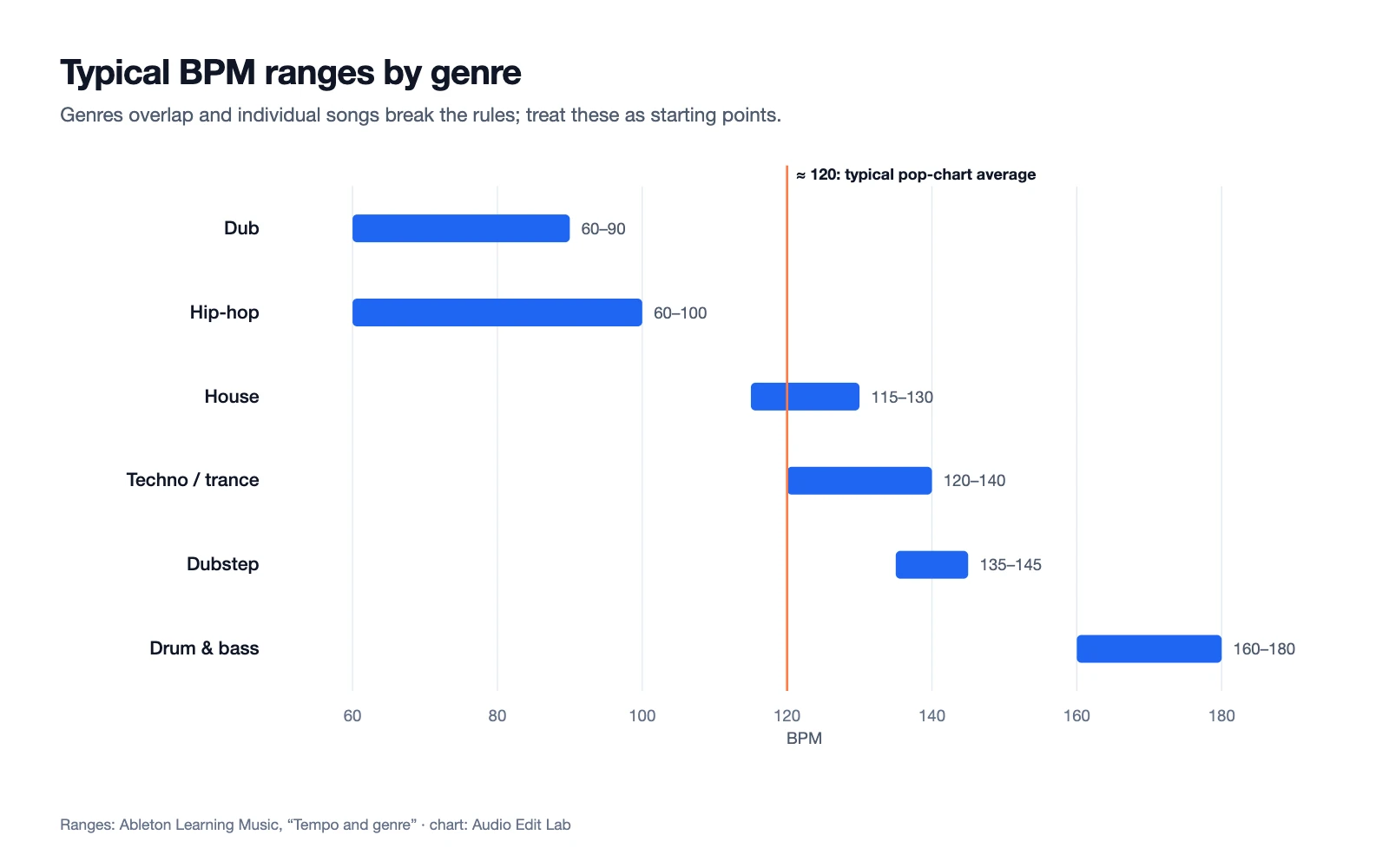
A few patterns are worth knowing. House sits in a tight band because DJs blend long sections. Dubstep is written at about 140 but usually feels like 70, because the snare lands only once per bar. Drum and bass runs at 160–180, mostly in the low 170s; our DnB BPM guide goes deeper. Hip-hop spans a wide range and is often counted in half time.
What is the average song BPM?
There's no official answer, but data analyses of popular songs keep landing in the same place: around 120 BPM on average, with most hits somewhere between 80 and 140. The average hides real clusters, though. Plenty of hits sit near 90–100 BPM (hip-hop, R&B, reggaeton), and another big group sits at 120–130 (dance-pop and house).
Half time and double time
A beat can be counted at two speeds. A trap song might be listed as 140 or 70, and a DnB track as 174 or 87, depending on whether you follow the hi-hats or the snare. Detectors make the same choice, so when a reading seems odd, try halving or doubling it before you trust it.
How to find the BPM of a song
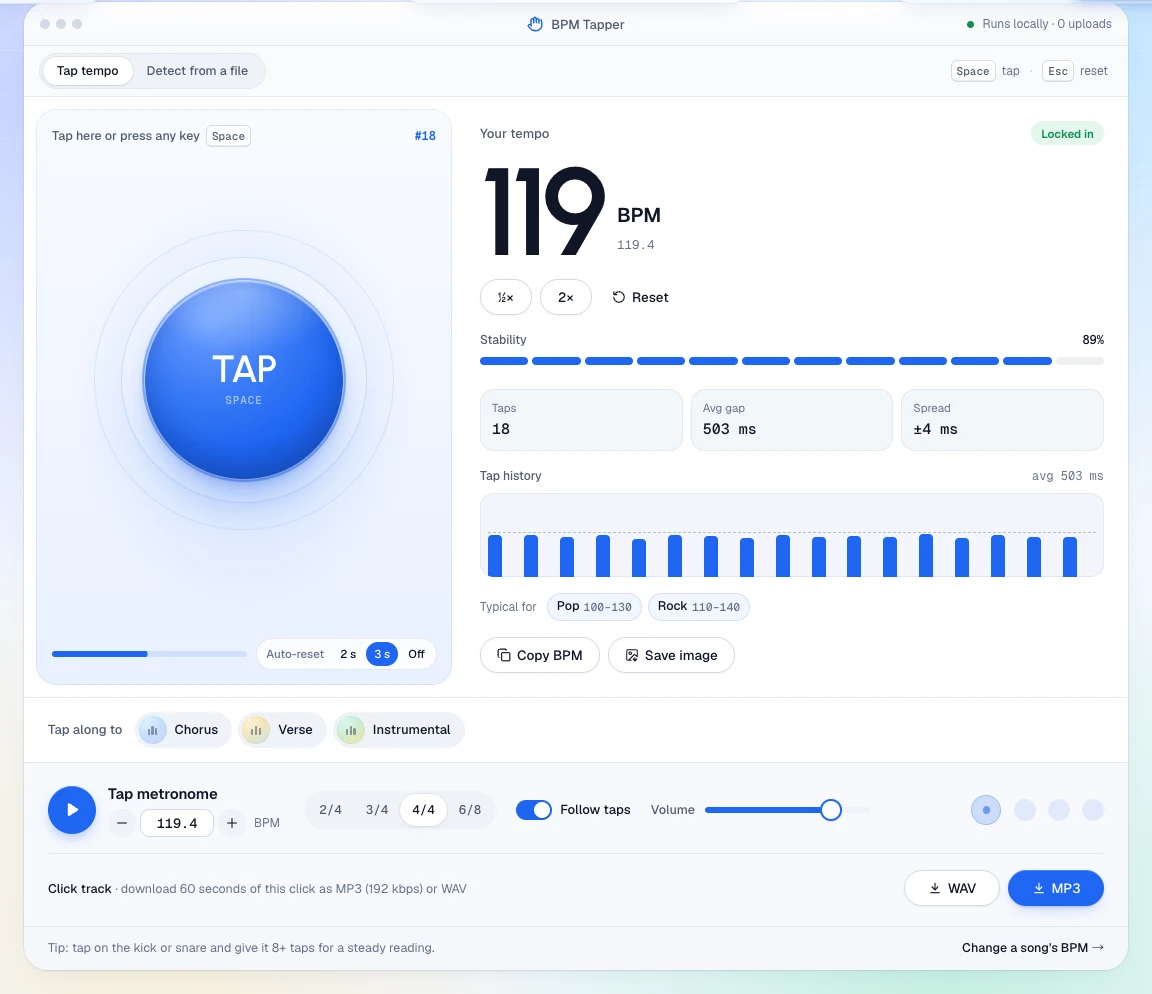
The quickest way is to tap along. Our BPM tapper turns your taps into a live reading and doesn't need the file at all.
- 1
Tap on the beat
Play the song and tap the pad (or press any key) on every beat, ideally on the kick or snare. After 8 or more taps the number settles and the stability bar fills.
- 2
Check half or double
If the result is around 70 for a song that feels driving, press 2×; if it's around 180 for a relaxed song, press ½×.
- 3
Or detect it from the file
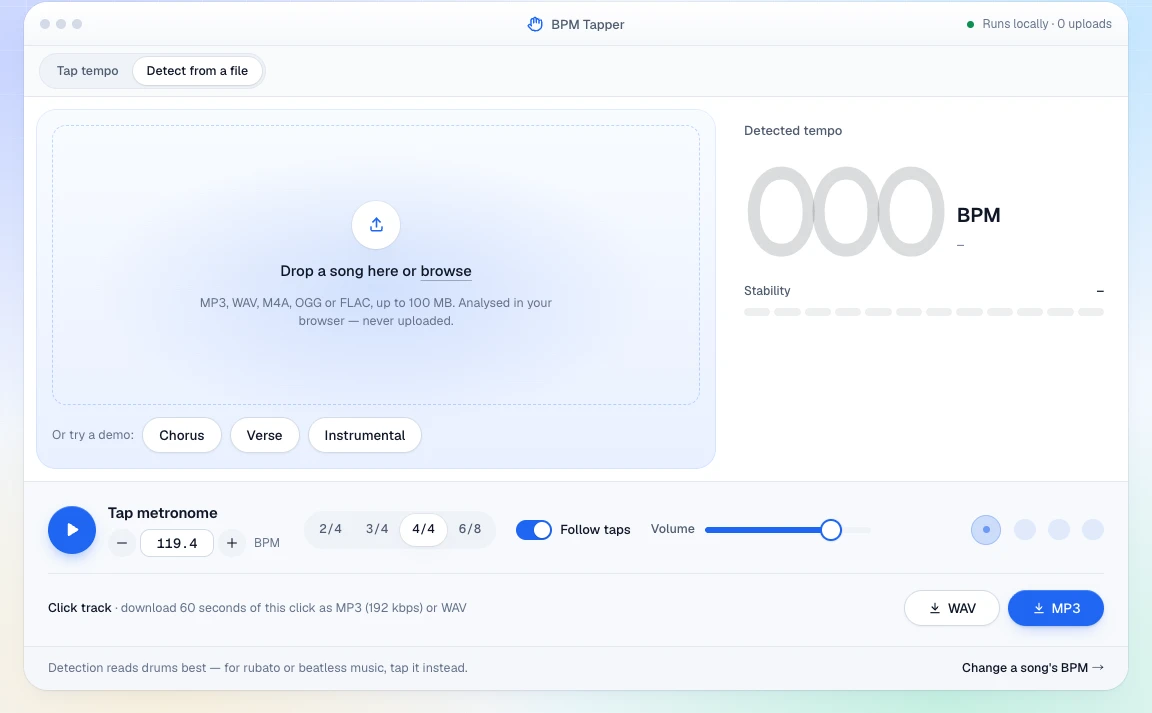
Switch to Detect from a file, drop in the song, and the tapper measures the tempo from the audio and shows the beat grid.
No tool handy? Count the beats for 15 seconds and multiply by 4. If you also need the musical key, the BPM and key finder reports both.
BPM TapperTap along to find the tempoTap the tempoHow to choose a BPM for your own track
If you're starting a song from scratch, the tempo is one of the first decisions, and it shapes everything after it.
- Start from the genre. Use the ranges above as a first guess: 85–95 for a laid-back hip-hop groove, 120–128 for house-flavoured pop, around 174 for drum and bass.
- Sing or rap the hook over a click. Words need room. If the phrase feels rushed, drop 5–10 BPM; if it drags, push it up.
- Think in half time. A 140 BPM project can carry a slow, heavy 70 BPM feel, which gives you fast hi-hats and a relaxed groove in the same song.
- Decide before you record. Changing BPM later stretches the audio, and big changes can leave artefacts, so lock it in while the song is still a sketch.
Why BPM matters
- DJs match the BPM of two tracks so their beats line up during a mix. That's why dance music is sold with the tempo printed next to the title.
- Producers set the project tempo first; loops, delays and drum machines all sync to it.
- Video editors cut on the beat, which is much easier when you know the seconds per beat.
- Remixers change BPM on purpose. A nightcore edit at 1.25× turns 120 BPM into 150; to change the tempo without changing the key, use the BPM changer.