
The short answer
Lofi = low fidelity, kept on purpose. Lofi hip hop is slow (about 70–90 BPM), jazzy and instrumental, with swung drums, detuned keys, vinyl crackle, tape hiss and muffled highs. It grew from 2000s beat-makers like J Dilla and Nujabes and became a genre through YouTube's 24/7 study streams.
What does lofi mean?
Lofi (also lo-fi or low-fi) means low fidelity. Hi-fi gear tries to reproduce sound exactly; lo-fi keeps the flaws: hiss, crackle, pitch wobble, distortion and a narrow band of frequencies. Wikipedia's lo-fi article notes that such recordings often carry little or nothing above 10 kHz, which is why lofi sounds soft and close, like music through a wall or an old radio.
The word was around for decades before it became a style. WFMU DJ William Berger is usually credited with popularising it through his radio show Low-Fi (1986–87), which played cheap home recordings. In the 1990s "lo-fi" described indie rock taped on four-track machines. Today, when someone asks what lofi music is, they almost always mean lofi hip hop: mellow instrumental beats built from jazz, soul and piano samples.
Where lofi hip hop came from
| When | What happened |
|---|---|
| Late 1990s–2000s | Underground beat-makers build tracks on samplers such as Roland's SP-303 and SP-404, which had a built-in lo-fi effect. Rough, sample-based hip hop becomes a sound in itself. |
| 2000s | Detroit producer J Dilla (James Dewitt Yancey, 1974–2006) turns off quantise on his Akai MPC3000, so drums land slightly early or late. That loose, "drunk" swing becomes the lofi groove. His album Donuts came out three days before his death in February 2006. |
| 2003–2005 | Tokyo producer Nujabes (Jun Seba, 1974–2010) releases jazz-sampling albums Metaphorical Music and Modal Soul and co-scores the anime Samurai Champloo (2004). He is widely called the godfather of lofi hip hop. |
| 2015–2017 | The YouTube channel ChilledCow, created in March 2015, starts a 24/7 "lofi hip hop radio – beats to relax/study to" livestream in February 2017. After a takedown over borrowed anime footage, it switches to an original animation of a girl studying by a window, drawn by artist Juan Pablo Machado. |
| 2020s | The channel renames itself Lofi Girl in March 2021. Its streams survive a brief removal in 2020 and false copyright claims in July 2022 (YouTube called them abusive and restored the streams). Wikipedia lists about 15.8 million subscribers. |
Facts above checked November 2026 against Wikipedia's articles on lo-fi music, J Dilla, Nujabes and Lofi Girl.
What lofi sounds like
Five ingredients do most of the work. You rarely need all of them, but most lofi tracks use three or four.
- A slow, steady tempo. Lofi hip hop usually sits at 70–90 BPM; Native Instruments' production guide puts it at around 60–90. See BPM by genre for how that compares with boom bap and house.
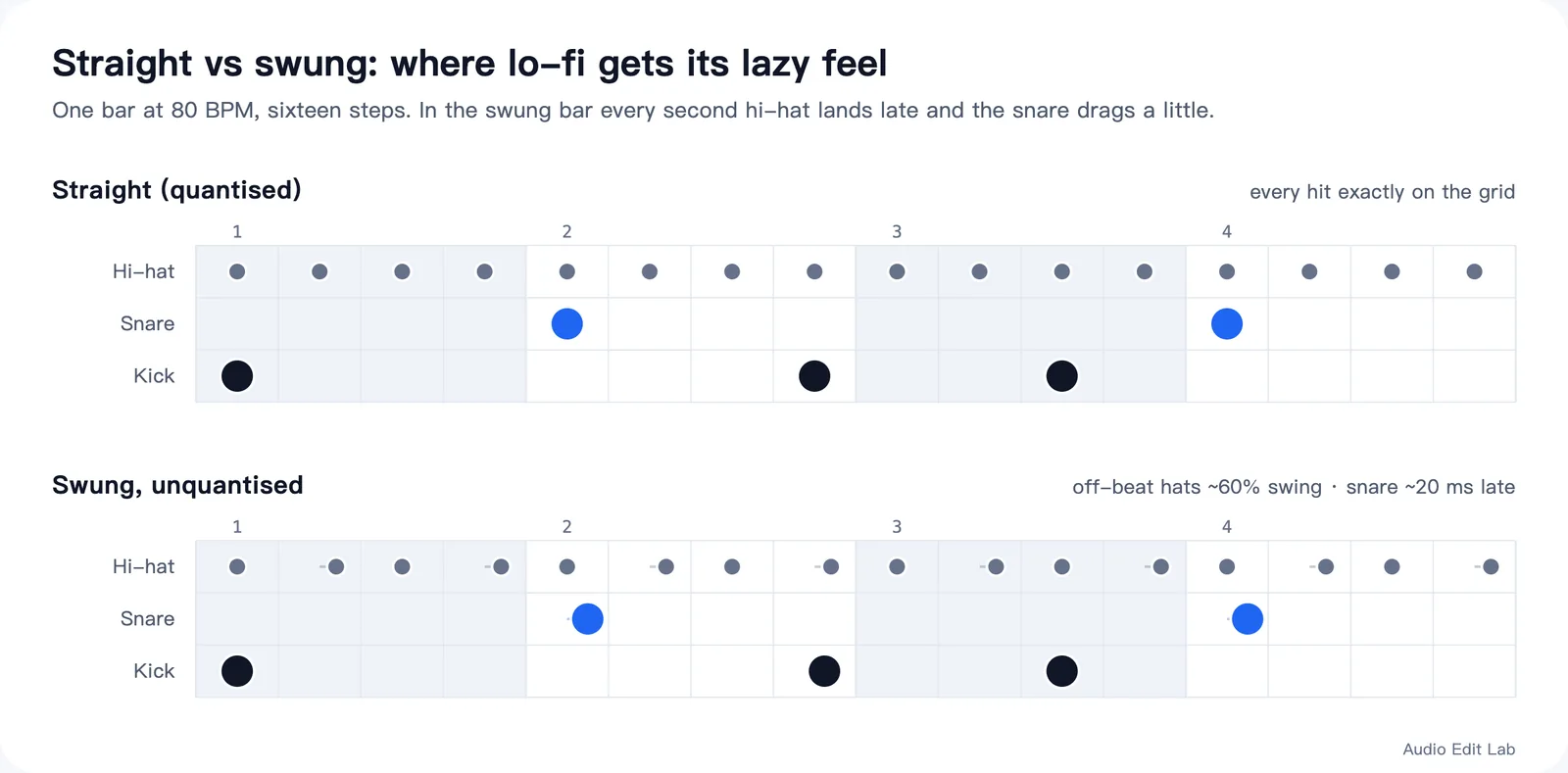
- Swing instead of a grid. Hi-hats push and pull, snares land a hair late. This is J Dilla's legacy: the beat feels relaxed because it isn't perfectly in time.
- Jazzy, slightly detuned keys. Seventh and ninth chords on an electric piano, a soft guitar or a sampled jazz record, often wobbling a little out of tune.
- Texture. Vinyl crackle, tape hiss and a faint wow-and-flutter wobble sit underneath everything, like room noise you stop noticing.
- Muffled highs. A low-pass filter or EQ rolls off the top end, so cymbals never sparkle. NI's tutorial, for example, filters the drum kit from about 3 kHz.

Lofi vs chillhop vs slowed + reverb
| Style | Tempo | How it differs |
|---|---|---|
| Lofi hip hop | 70–90 BPM | Original instrumental beats; swing, crackle, hiss, muffled highs |
| Chillhop | about 80–95 BPM | Often used as a synonym; usually a bit cleaner and brighter |
| Slowed + reverb | original × 0.8–0.9 | An edit of an existing song: slower, lower and washed in reverb |
| Lo-fi house | about 110–124 BPM | Same dusty textures on a four-on-the-floor dance beat |
How to make the lofi sound in your browser
You don't need a DAW to give a song lofi colour. These free tools run on your device, so nothing is uploaded.
- 1
Slow it down and add a soft room
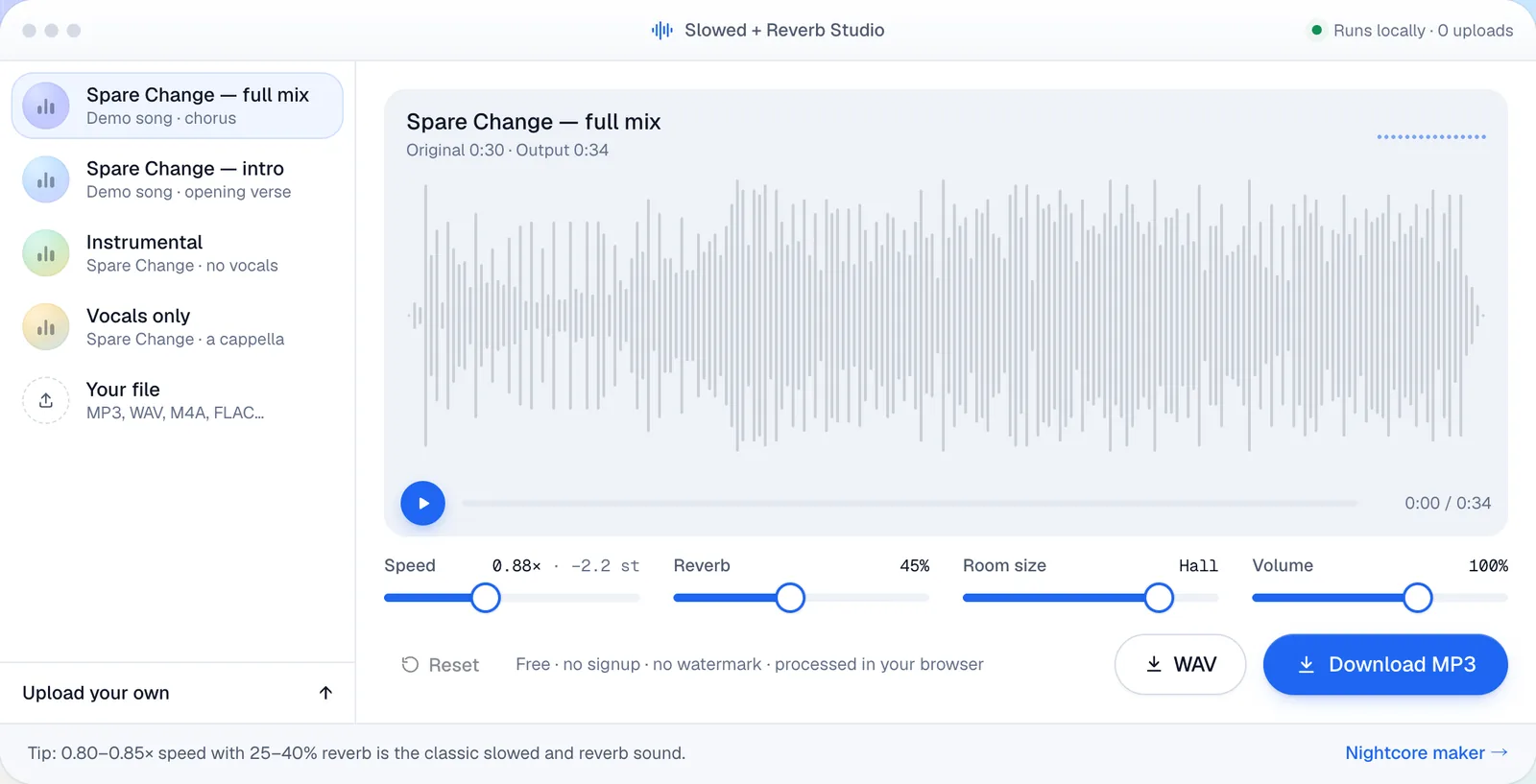
Open the slowed + reverb studio and drop in a song. The Lo-fi Late Night look sets 0.88× speed (about −2.2 semitones) and 45% reverb in a hall: laid back, not sludgy.
- 2
Cut the highs and the deepest lows
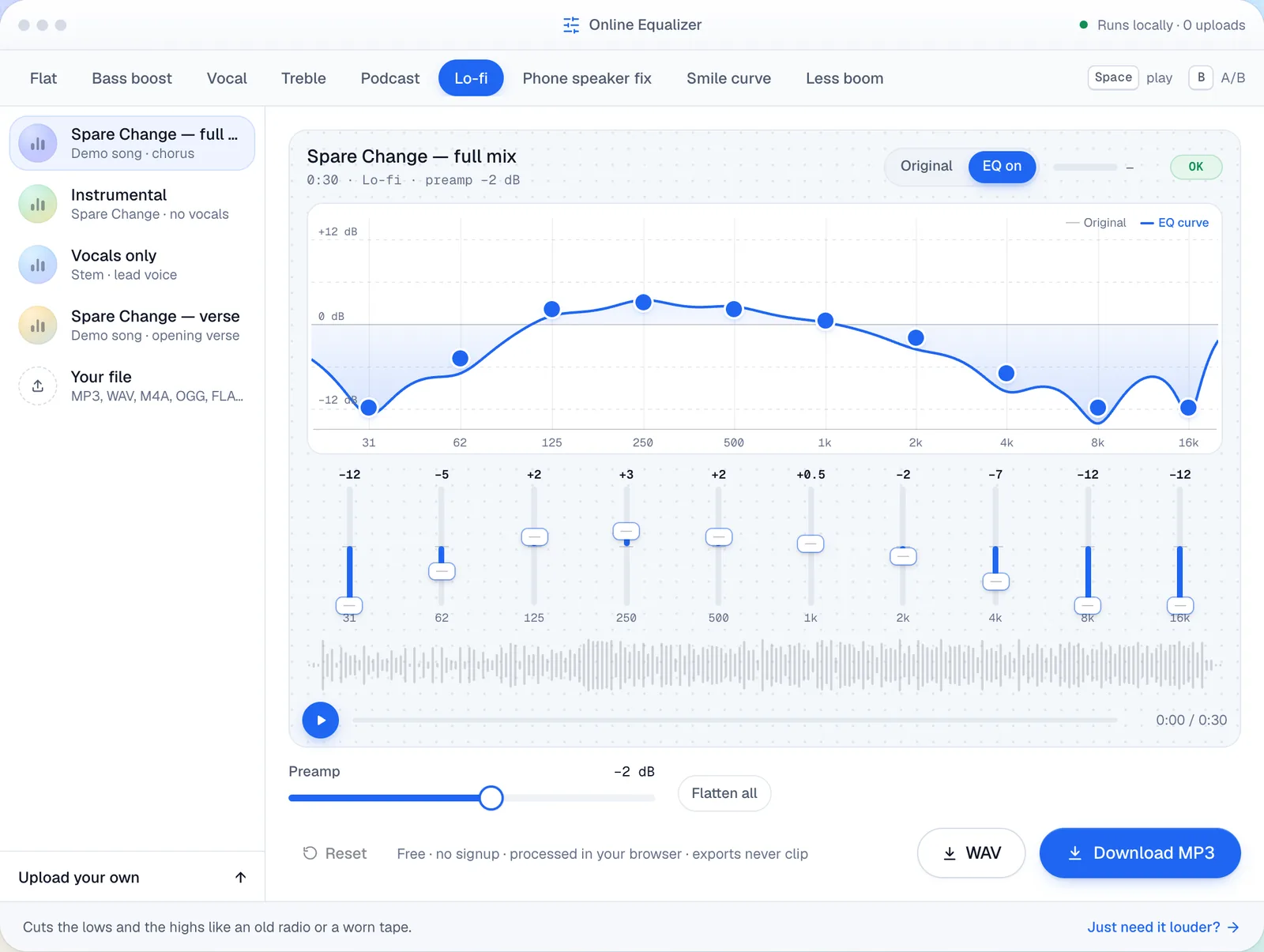
In the online equalizer, choose the Lo-fi preset. It pulls 8–16 kHz and 31 Hz down by 12 dB and lifts 250 Hz by 3 dB, the boxed-in sound of a small speaker.
- 3
Add tape wobble and hiss
The VHS audio effect adds the tape side: wow and flutter, hiss and a narrower band. Keep it subtle; you should feel the wobble more than hear it.
- 4
Check the tempo
Tap along in the BPM tapper. If the song is far above 90 BPM, bring it down with the BPM changer, which keeps the key.
Tips for a convincing lofi edit
- Start from the right song. Acoustic, piano or R&B tracks around 80–100 BPM turn lofi easily. Dense EDM rarely does.
- Filter first, then add noise. Hiss on top of bright cymbals just sounds broken. Roll off the highs, then add texture.
- Less reverb than you think. Lofi is close and intimate; long tails push it toward ambient.
- Mind the vocals. Slowing past about 0.85× drags voices down noticeably. For an instrumental feel, use an instrumental version.
Sharing lofi edits
Making a song sound lofi doesn't change who owns it. Post edits of music you have the rights to, and keep other edits for personal listening.
Curious why lofi feels so different from other slowed styles? Compare it with nightcore, which runs the same speed-and-pitch link in the other direction.