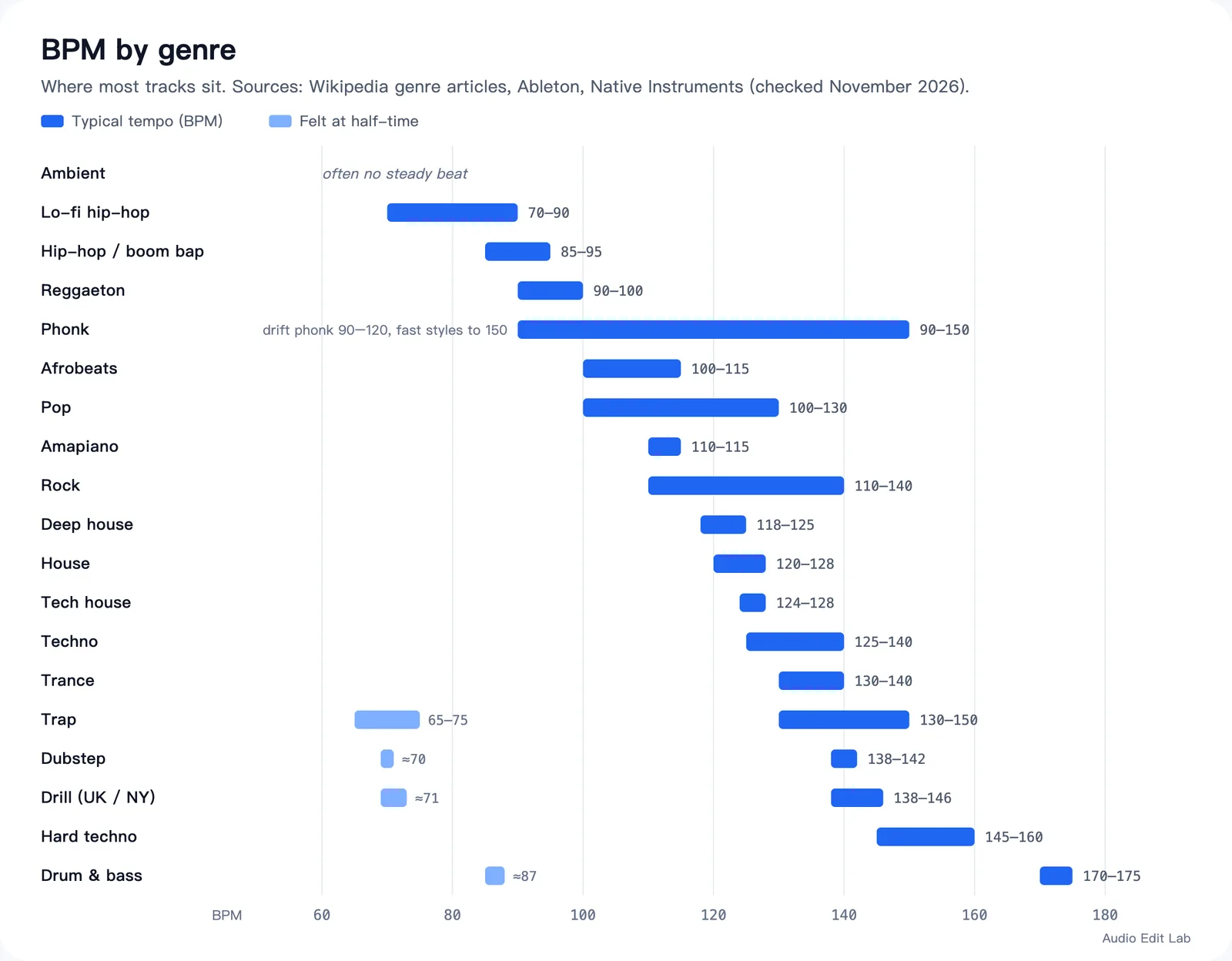
Quick answers
House 120–128 BPM · techno 125–140 · hard techno 145–160 · trap / dubstep / drill about 140 (felt at 70) · drum & bass 170–175 · hip-hop 85–95 · reggaeton 90–100 · afrobeats 100–115 · lo-fi 70–90. These are where most tracks sit, not rules.
BPM by genre: the full table
"Typical" is where most current tracks land; "References" shows what the sources say. Genres overlap, so a 128 BPM track could be house, techno or trance: the drums and sound design decide, not the number alone.
| Genre | Typical BPM | References (checked November 2026) | Feel / notes |
|---|---|---|---|
| Ambient | no fixed tempo | Often beatless | When there is a pulse, usually slow |
| Lo-fi hip-hop | 70–90 | 60–90 (Native Instruments); 70–90 (RouteNote) | Swung, laid back |
| Hip-hop / boom bap | 85–95 | Hip-hop 60–100 (Ableton); NI's boom bap tutorial uses 93 | Doubles into drum & bass |
| Reggaeton | 90–100 | NI's tutorial uses 90 | Dembow 3+3+2 rhythm |
| Phonk | 90–150 | Drift phonk ~90–120 (NI); faster styles reach 150 | Cowbells, distorted 808s; varies by style |
| Afrobeats | 100–115 | DJ and producer guides; no formal standard | Many hits at 105–110 |
| Pop | 100–130 | Hits slowed toward ~90 in the late 2010s (Rolling Stone, 2018) | Widest spread of any genre |
| Amapiano | 110–115 | "In the 110 BPMs" (NI; tutorial at 114) | Log-drum bass, deep-house roots |
| Rock | 110–140 | Very wide; ballads slower, punk 160+ | Played live, so tempo drifts |
| Deep house | 118–125 | 110–125 (Wikipedia) | Warmer, slower than club house |
| House | 120–128 | 115–130 (Wikipedia, Ableton) | Four-on-the-floor kick |
| Tech house | 124–128 | Producer guides; NI tutorial at 130 | House groove, techno sounds |
| Techno | 125–140 | 120–150 (Wikipedia); 120–140 (Ableton) | Faster in peak-time sets |
| Trance | 130–140 | 120–150, production 125–150 (Wikipedia) | Long builds, big breakdowns |
| Trap | 130–150 | "Around 70 (140)" (Wikipedia) | Felt at 65–75 |
| Dubstep | 138–142 | 132–142, most at 140 (Wikipedia) | Felt at about 70 |
| Drill (UK / NY) | 138–146 | ~138–151 (Wikipedia, UK drill); NI tutorial at 146 | Half-time feel, sliding 808s |
| Hard techno | 145–160 | "140 to 160 BPM zone" (Mixmag, 2025) | 2020s rave tempo |
| Drum & bass | 170–175 | 160–180 (Ableton) | Felt at about 87 |
Sources: Wikipedia's genre articles, Ableton's Learning Music tempo page, Native Instruments' production tutorials, Mixmag and Rolling Stone, all checked November 2026. Where they disagree, the "typical" column takes the range most of them share. Two styles have their own guides: drum & bass BPM by sub-genre, and what lofi music is.
House BPM: what BPM is house music?
House music BPM is usually 120–128, with 124–126 the classic club pocket. Wikipedia gives house an overall range of about 115–130 BPM, and Ableton's tempo guide agrees (115–130). Within the family:
- Deep house sits lower, about 118–125; Wikipedia gives 110–125.
- Tech house sits at 124–128, sometimes up to 130.
Because almost every house track is within a few BPM of the others, DJs can mix long, smooth blends with tiny pitch changes, around ±2%, which is hard to hear.
Techno BPM and hard techno BPM
Techno BPM is broader: Wikipedia gives 120–150, Ableton 120–140, and most current techno sits at 125–140. Warm-up sets start lower; peak-time sets push higher.
Hard techno sped up in the 2020s. Mixmag described one leading artist's music as living "in the 140 to 160 BPM zone" in 2025, and 145–160 is where most hard techno sits today. Harder, older styles such as hardcore go faster still (160–200+).
Hip-hop, trap, drill and phonk BPM
Classic hip-hop and boom bap sit at 85–95 BPM, a head-nod tempo built around a sampled break. Trap moved the grid up to about 140 while keeping the same slow nod, thanks to the half-time snare and rapid hi-hat rolls. UK and New York drill sit in the same pocket (Wikipedia gives UK drill about 138–151 BPM) with sliding 808s and syncopated kicks. Phonk, which grew out of 1990s Memphis rap, is the loosest of the group: Native Instruments puts modern phonk, especially drift phonk, at about 90–120 BPM, and faster styles push toward 150. Latin and African styles sit between them: reggaeton at 90–100, afrobeats at 100–115, amapiano at 110–115.
Half-time and double-time: why one song has two BPMs
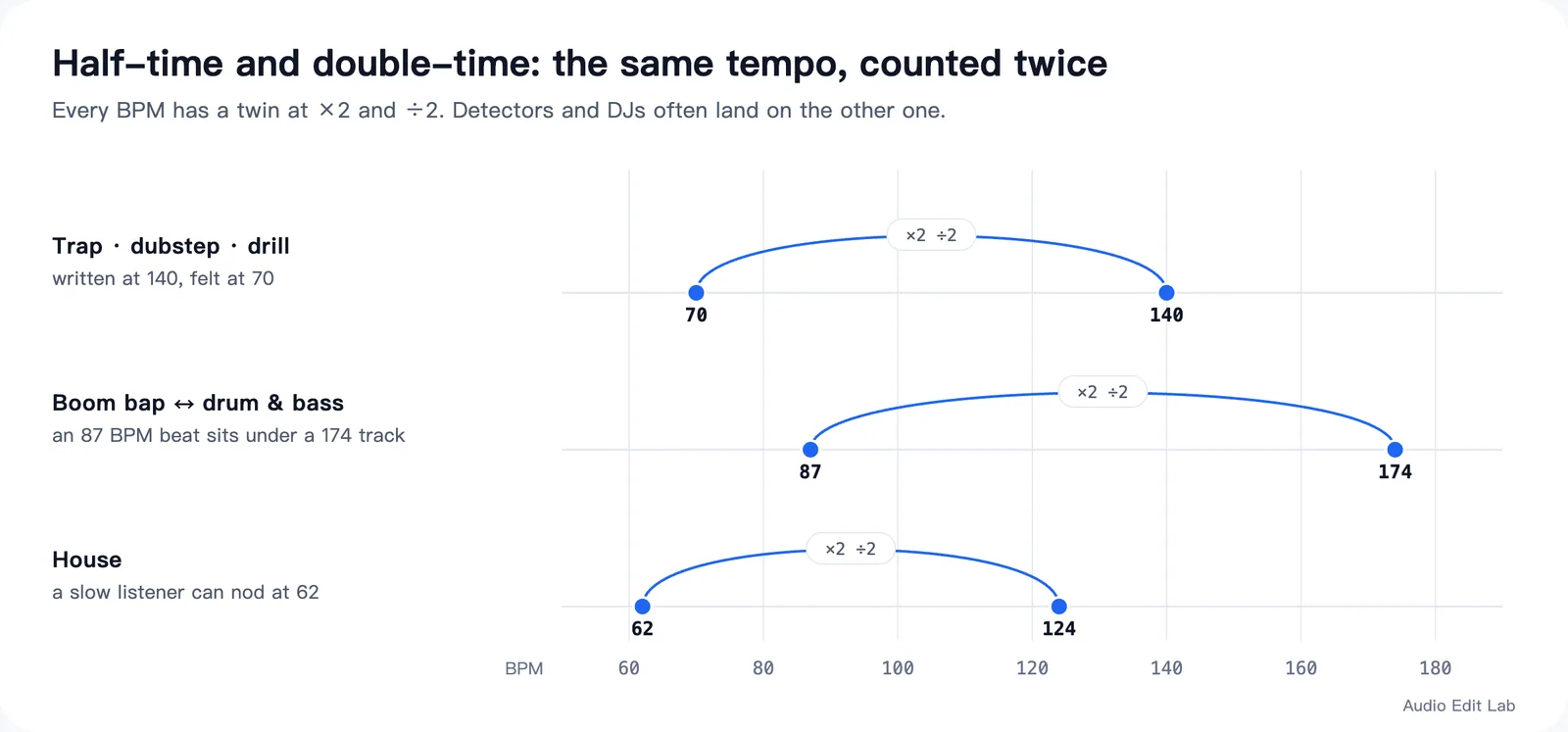
Tempo is ambiguous by a factor of two. A trap, dubstep or drill beat is programmed at about 140 BPM, but the snare lands only on beat 3, so your head nods at 70. Wikipedia writes trap tempo as "around 70 (140) BPM" for exactly this reason. Run the other way and double-time appears: an 87 BPM boom bap beat lines up perfectly under 174 BPM drum & bass.
This is why BPM detectors and tap-tempo apps sometimes give half or double the number you expect. Neither is wrong; they counted a different layer of the beat. Pick the value your genre (or DJ software) uses: trap and dubstep are listed at 140, drum & bass at 174, hip-hop at 85–95.
How to find a song's BPM
- 1
Tap it
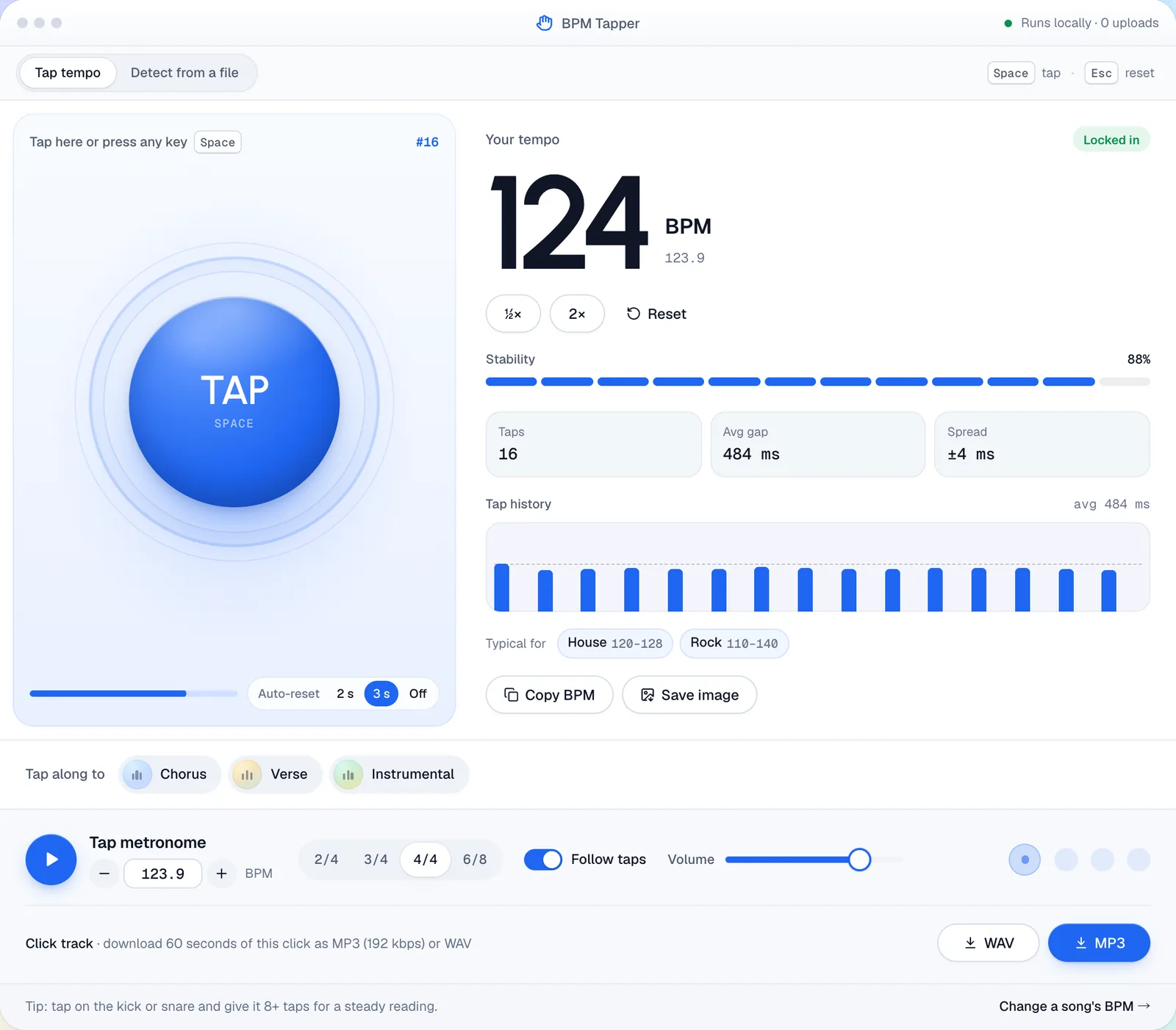
Open the BPM Tapper, play the song and tap Space on every kick or snare for 8–16 beats. It shows the BPM, how steady your taps are and which genres usually sit at that tempo.
- 2
Or detect it from the file
The tapper's Detect from a file tab, or the BPM & Key Finder for whole folders, reads the tempo from the audio in your browser. The key finder also gives the musical key and Camelot code.
- 3
Sanity-check the octave
Got 70 for a trap song? That's the half-time feel; it's listed at 140. Got 87 for drum & bass? Double it to 174.
Practise at any genre's tempo
Knowing a number is one thing; feeling it is another. Set a click to the genre's tempo and play, program or dance along until it sits in your body.
- House at 124: open the online metronome at 124 BPM and accent beat 1.
- Trap and drill at 140: use the metronome at 140, then practise counting the half-time 70 over it.
- Lo-fi at 80: 80 BPM with eighth-note subdivisions is a good place to practise playing slightly behind the click.
To move a whole song into another genre's range, the BPM Changer retimes it and keeps the key.
New to tempo? Start with what BPM means; for everything about 170–175 BPM, read the DnB BPM guide.