
The short answer
Use Tunebat when you only know a song's name: it looks up key and BPM in a database of 100+ million tracks. Use our BPM & Key Finder when you have the file and want the analysis on your device, with confidence scores, a Camelot wheel and a by-ear check. Both are free to start.
What Tunebat does (checked November 2026)
Everything here comes from tunebat.com as it read on 16 November 2026. Plans and features change, so check the site before you pay.
- Music database. Search any song and see its key, BPM, Camelot code and popularity. Tunebat says it covers "over 100 million songs" and the footer credits the Spotify Web API; its FAQ adds that these key and BPM values come from Spotify's own estimation algorithms. An Advanced Search finds tracks by key, BPM, energy, danceability and more from up to five seed songs or artists.
- Key & BPM Finder (Analyzer). Drop in your own audio: MP3, WAV, FLAC, AAC, OGG or M4A. In standard mode it "runs privately in your browser, so your files never leave your device", with no stated limit on file count or size. It is built on Essentia.js and Essentia models from the Music Technology Group at UPF.
- Analyzer Pro. Adds a High Accuracy mode (a MusicalKeyCNN model that Tunebat says is 11% more accurate than standard), energy, danceability and happiness estimates, analysis settings and no ads. High Accuracy files go to Tunebat's server and are deleted right after analysis. $7.99/month, or $2.99/month billed yearly ($35.88).
- More tools. Vocal remover, song mastering, key & BPM changer, BPM tapper, metronome, a music video maker and an API. The Full Package bundles the Pro tools for $19.99/month ($11.99/month billed yearly); Remove Ads alone is $12/year.

How our BPM & Key Finder is different
Our BPM & Key Finder only does the second job, analysing files you have, and puts more of the analysis on screen.
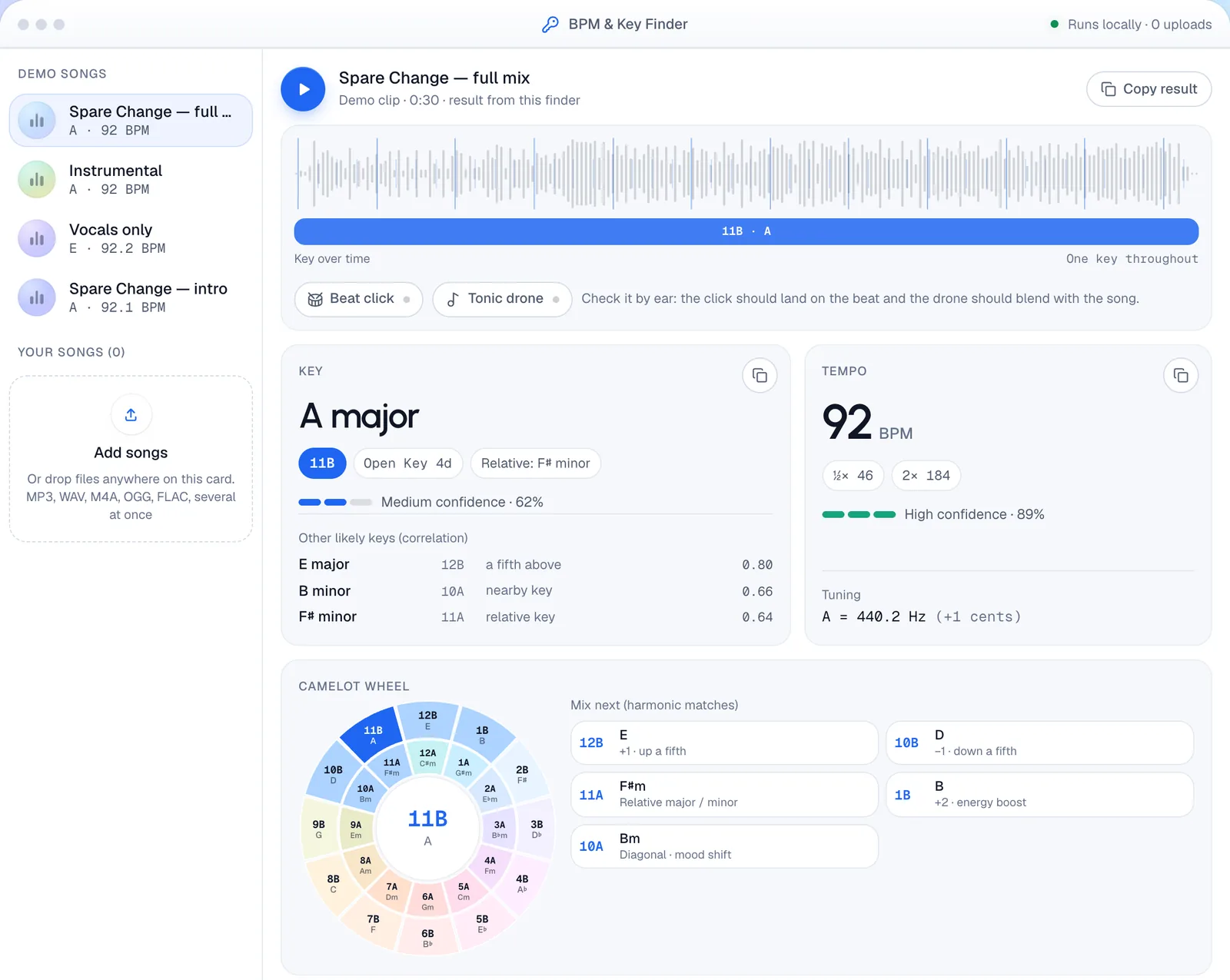
- Runs in your browser only. Every file is decoded and analysed on your device. There is no server mode and no account.
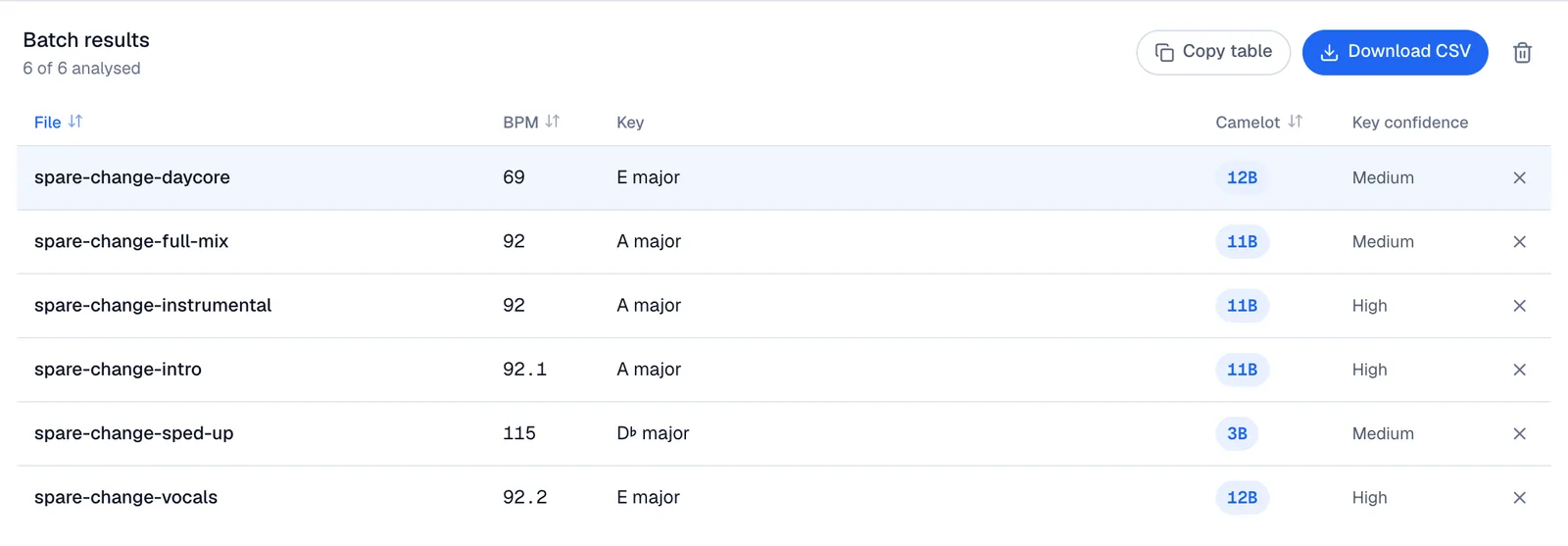
- Batch up to 40 files (100 MB each) into one table you can sort by BPM or Camelot code, copy or download as CSV.
- A Camelot wheel with "mix next" suggestions: the same key, ±1 on the wheel, the relative major or minor, the +2 energy boost and the diagonal move.
- Confidence you can see. A confidence level for key and tempo, the runner-up keys with their correlation scores, a key-over-time strip and the tuning offset in cents.
- Check it by ear. Switch on a beat click and a tonic drone while the song plays. If the drone clashes, the key is wrong.
- Half- and double-time values next to every BPM, plus Open Key notation for Traktor users.
What it doesn't do: look up songs you don't have, recommend similar tracks or estimate energy and danceability.
Tunebat vs Audio Edit Lab at a glance
| Tunebat (checked November 2026) | Audio Edit Lab BPM & Key Finder | |
|---|---|---|
| Look up a song by name | Yes, 100M+ songs (Spotify Web API data) | No, needs the audio file |
| Analyse your own files | Yes; in the browser (standard) or on its server (Pro High Accuracy) | Yes, in the browser only |
| Files per run | No stated limit | Up to 40, 100 MB each |
| Formats | MP3, WAV, FLAC, AAC, OGG, M4A | MP3, WAV, M4A, OGG, FLAC |
| Results | Key, BPM, Camelot; energy, danceability, happiness with Pro | Key, relative key, Camelot + Open Key, BPM with ½× / 2×, tuning |
| Confidence and alternatives | Not described on the analyzer page | Confidence levels, runner-up keys, key over time |
| Harmonic mixing help | Camelot codes, song recommendations | Camelot wheel with "mix next" matches |
| Price | Free with ads; Analyzer Pro $7.99/mo or $35.88/yr | Free, no signup |
Is Tunebat accurate? And is ours?
No key or BPM finder is right every time, and Tunebat's own analyzer page says all results "are estimates". Three things are worth knowing:
- The database and the analyzer can disagree. Tunebat explains that database values come from Spotify's algorithms and file results from its own, and that your file may differ from the one Spotify analysed.
- BPM errors are usually octave errors. A 140 BPM trap beat felt at 70, or drum & bass detected at 87 instead of 174. See BPM by genre for the usual values.
- Key errors are usually near misses: the relative key or a key a fifth away, which still mix well.
For Tunebat, the company states its High Accuracy mode is the most accurate key detection available online, citing a 2025 community comparison of 20 key detection tools on more than 2,000 tracks. We haven't tested Tunebat ourselves, so we don't publish a number for it.
We did measure ours, with the same code that runs on the page (November 2026):
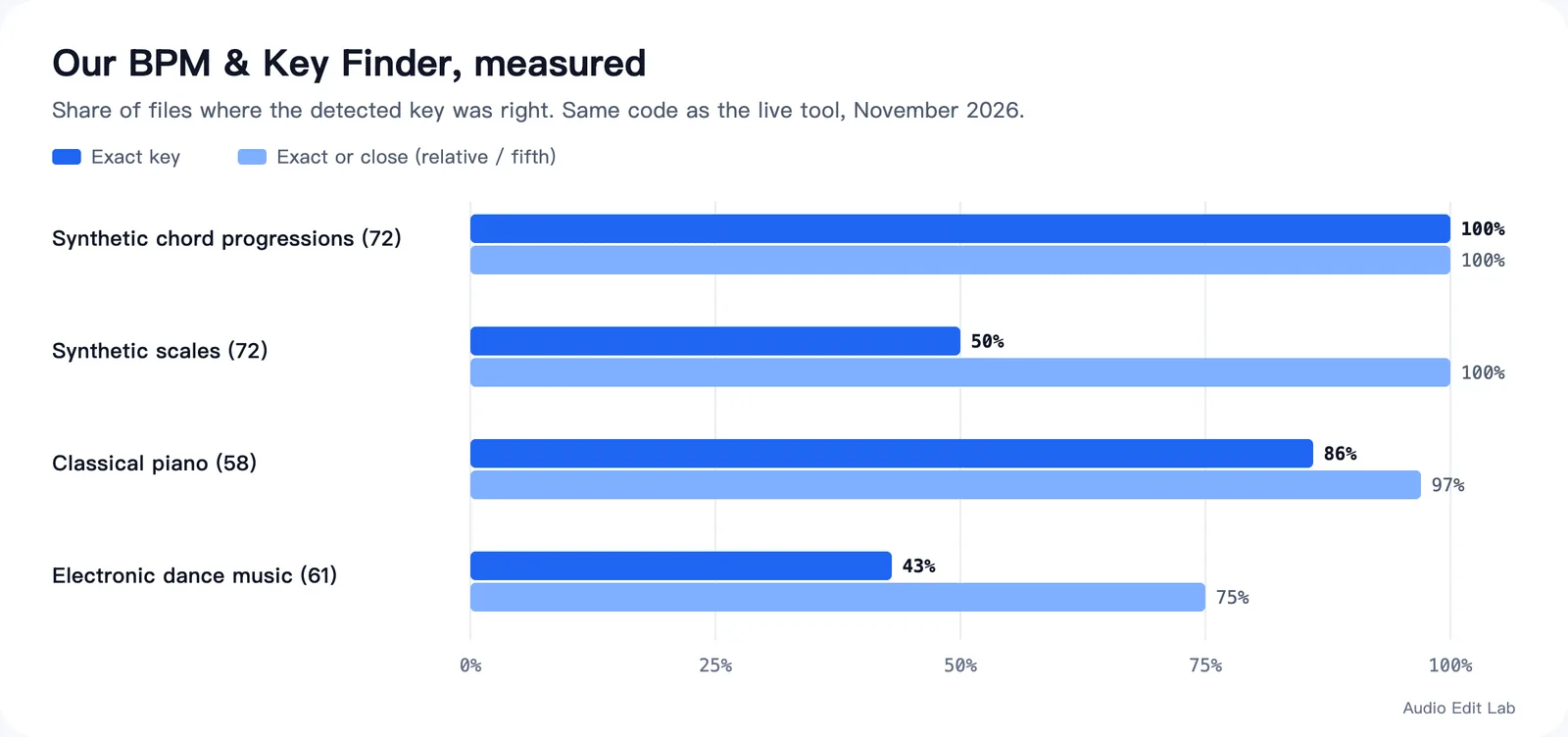
Tonal music with clear chords is easy for template-based finders; loop-based dance tracks are hard for all of them. That is why ours shows confidence, the runner-up keys and a tonic drone instead of a single bare answer. Full method and test sets are on the BPM & Key Finder page.
When Tunebat is the better choice
- You don't have the file. Tunebat's database answers "what key is this song?" from the title alone.
- You want discovery. Its recommendations and Advanced Search find tracks by key, BPM, energy or danceability.
- You need energy, danceability or happiness scores, or a server-side CNN key model for a large electronic library (Pro).
- You want to analyse a huge library in one go (no stated file limit) or need an API.
Ours fits better when you already have the files, want nothing to leave your device, want to see how sure the result is, or are planning a harmonic DJ set from the Camelot wheel.

Finding key and BPM: a quick workflow
- 1
Get the numbers
Drop your tracks into the BPM & Key Finder, or tap a tempo by hand in the BPM Tapper.
- 2
Check the doubtful ones
Low confidence? Turn on the tonic drone and listen, and look at the ½× / 2× values if the tempo seems off.
- 3
Fix what doesn't fit
Move a track up or down a semitone with the pitch changer, or retime it with the BPM changer without changing its key.

Tunebat is a trademark of Tunebat LLC. Audio Edit Lab is not affiliated with Tunebat.